I, Bernie Harberts, did not use generative AI to write or illustrate this article. Spell check and grammar check, yes. AI, no.
Who knew how much pleasure a waxed canvas tarp, a vintage sewing machine, and a borrowed covered wagon could bring a fellow? I found out this week when I sewed a new wagon cover for my friend Ronald Hudson’s wagon.
Ronald’s covered wagon. He loaned it to me for an upcoming trip filming a special about Lake Mattamuskeet for PBS North Carolina. The tarp laid out in the foreground will become the new wagon cover. I took this photo at 4:30 pm. The light in my tool shed is already on because it was getting dark up the Shoebox canyon, where my wife Julia and I live.
We’re approaching December 21, the winter solstice. As the night time temperatures dip into the upper teens here western North Carolina, I find myself coming in earlier and earlier after chores. By 5:30 pm, it’s hard dark, and my Julia and I settle in for the evening. It’s cozy in our cabin, with the wood stove radiating a bone-warming heat, a pot of beans on the stove, and the border collies hunkered around Julia and me after their long day of chasing each other and airplanes. We feel grateful to be out of the cold.
Supper’s cooking and I hope you like beans. The oval pot is full of beans and the round one is heating tea water. The wood stove, a Woodstock, is our only source of heat.
Lucky eyeing our supper. We don’t eat beans every night. Here, she’s staring down some home-raised beef that our dear friends Craig and Laura Pearson gave us.
And yet, despite the domestic, bliss, I feel a touch of seasonal melancholy. As the nights get longer , colder and darker, I feel that I don’t have as much time left as I used to. We can say that at any age, but now that I’m in my late fifties, I feel it more strongly. In my thirties and forties, life stretched ahead of me to the vanishing point on a horizon that seemed infinitely far away. Having that horizon get a notch closer every day makes everything sweeter because you know that no journey lasts forever.
That lends Julia’s and my evening projects an extra sweetness. Julia is making Christmas gifts for friends. I’m sewing a new cover for the wagon sitting behind our cabin.
A Borrowed Covered Wagon
I plan to use the covered wagon on a short ramble with my mule Polly in mid-January. It’s not my wagon. I borrowed it from my dear friend Ronald Hudson, the same friend from whom I bought my mule Polly many years ago. In addition to being a great friend, Ronald is incredibly generous. Over the years, he has loaned me mules, wagons, gear, trailers, a set of saddle bags that smelled like vomit and even let me keep Polly at his place when I wasn’t able to keep her at mine. In exchange, I have trimmed his mules’ feet, given wagon rides with him and helped him mend fences. It’s one of those easy friendships where favors cheerily flow back and forth. In the age of We Need to Own Everything, it’s a reminder that if you have great friends, you can pool energy and resources and have everything you need without owning it all.
I love this wagon. It’s a one-horse field wagon with wood wheels, a traditional bed, and white oak hoops. Who knows how old it is, but it’s been sitting in Ronald’s barn for as long as I can remember. When I asked Ronald if I could use it for my upcoming ramble, he said I could. It’s one of Ronald’s best wagons, which just shows you how good a friend Ronald is.
Ronald helping me load his wagon into our trailer. It had to be disassembled to fit into the trailer because it was too wide to roll on. When I showed Ronald this photo, he laughed and said, “Yeah, look at ol’ Eagle Eye making sure you load up his good wagon right!” And then, of course, he laughed.
May Need Some Repairs
Okay, so the wagon was really nice but not perfect. It needed a new set of shafts, the slim pieces of wood that go on either side of the horse or mule pulling the wagon. It was also missing its canvas top. I told Ronald I’d build a new set of shafts and a canvas cover in exchange for letting me borrow his wagon.
I brought the wagon home, re-assembled it and built a new set of shafts for it, which you can read about here. This week, I finally got around to sewing a new canvas cover for it.
Traditionally, covered wagon covers were made of heavy canvas treated with wax, oil or whatever gooey substance could be rounded up and slathered on the material to make it waterproof. Instead of remaining faithful to tradition, I drove down to Tractor Supply and bought a waxed 8′ x 10′ canvas tarp. It’s actually a great tarp. The label bragged on the features the pioneers could have only dreamed about. 100% Breathable Duck!Double-stitched Hems and Seams! Durable Steel Grommets! Made in China! Okay, you would have to have explained that last one to a pioneer.
How my wagon covered started.
Sure, I could have just lashed the tarp across the wagon bows, the bent wood hoops that support the cover.
A covered wagon with the square cover just drawn in tight, instead of shaped to the wagon bows. This, of course, works just fine.
But I wanted to do better. I’ve always loved how the tops of covered wagons pull down around the front and back openings, like a shawl pulled around a face. To do that, I needed to cut the tarp to shape and sew in a draw string. Here are some photos of how I laid things out and sewed them up.
The tarp laid out next to the wagon ready to be fitted. I used the ladder to position the tarp on the wagon for a rough fitting.The tarp laid over the top of the wagon bows. Hey, this shows promise!Polly drifted by for a look, blissfully unaware of what plans I have for the wagon…and herWhile the tarp was on the wagon, I marked where it needed to be trimmed to shape. The angled white lines on the left side of the tarp are chalk marks where I’ll cut the tarp so it conforms to the wagon bows.
Next, I cut the tarp to shape. This is where you want to make sure you got your measurements right.
Cutting the tarp to shape. This doesn’t have to be perfect, just close, because the edge will be hemmed.Done. Whew, the pressure’s off, now!
Once I had the tarp cut to fit, I fitted the length of paracord that would be the drawcord to draw the cover tight up against the wagon’s steam-bent oak bows.
The paracord I’ll use to make the drawstring at the front and back of the wagon cover.Working in the drawcordThe draw cord folded into a seam. The fold is held in place with needles until I sew it.Because the edge is curved, I had to put a few minor folds into the seam to keep it from wrinkling up while I sew it
With everything laid out, it was time to bring the cover inside and sew up the front and back drawstring. That occupied two pleasant evenings.
Spending an evening on my beloved sewing machine. Julia is reading on the couch behind me. My sewing machine is a vintage, heavy-duty White model 167. I bought it on Craigslist for a hundred dollars. That was complete with a sewing stand and all accessories, right down to spare bobbins, thread, chalk (for marking seams) and a seam ripper (for when you screw up).
lick on the player to catch the sewing action
Just One Problem
So for a few evenings’ of satisfying work, I came out with a beautiful cover for Ronald’s wagon. I took it out in the back yard, laced it onto the wagon and it looked amazing. I could just imagine hoping into the wagon, hitching Polly and heading west.
The cover fitted to the wagon. I love how the drawstrings, when pulled tight, makes such a graceful curve.The side view of the new wagon cover
There was only one problem. The wagon cover was in place, it interfered with the brake handle. That meant I couldn’t use the brake when using the wagon. I decided my next project would be to make the wagon cover reef-able. That is, make it so the front of the cover could be folded away while I was driving, so I could reach the brake lever.
And that, my friend, is where we pick up the story the next time.
I hope you’re cozy and well wherever you are. If the melancholy effects of winter feel more like the blues to you, or even something heavier, I wish you the best getting back to a better place.
Heading into winter: the first snow on one of the wagon’s wheels. I’ve been keeping Ronald’s wagon in a barn but this dusting of snow crept up on me. Don’t worry ol’ Eagle Eye, I’m not leaving your wagon out in the rain!
Watch Swan Song, Free on YouTube
Not long after I sewed the new cover for Ronald’s covered wagon, I hauled it and my mule Polly to Lake Mattamuskeet, North Carolina. Joining us was a film crew with PBS North Carolina. The same day that we started our ramble, a snowstorm blew in.
Mule Polly and I holed up in the covered wagon at a church in Fairfield, North Carolina, on the shores of Lake Mattamuskeet. I filmed the whole experience, from what it was like to have snow blow under the wagon cover to cooking wild duck on my wood stove.
Waiting out the snow in Fairfield, NC. Note how well the new wagon cover is keeping the snow out of the wagon.
We got back on the road, PBS NC filmed the rest of the ramble and Morgan Potts turned it into the incredible double-feature that premiered on PBS NC’s My Home NC program.
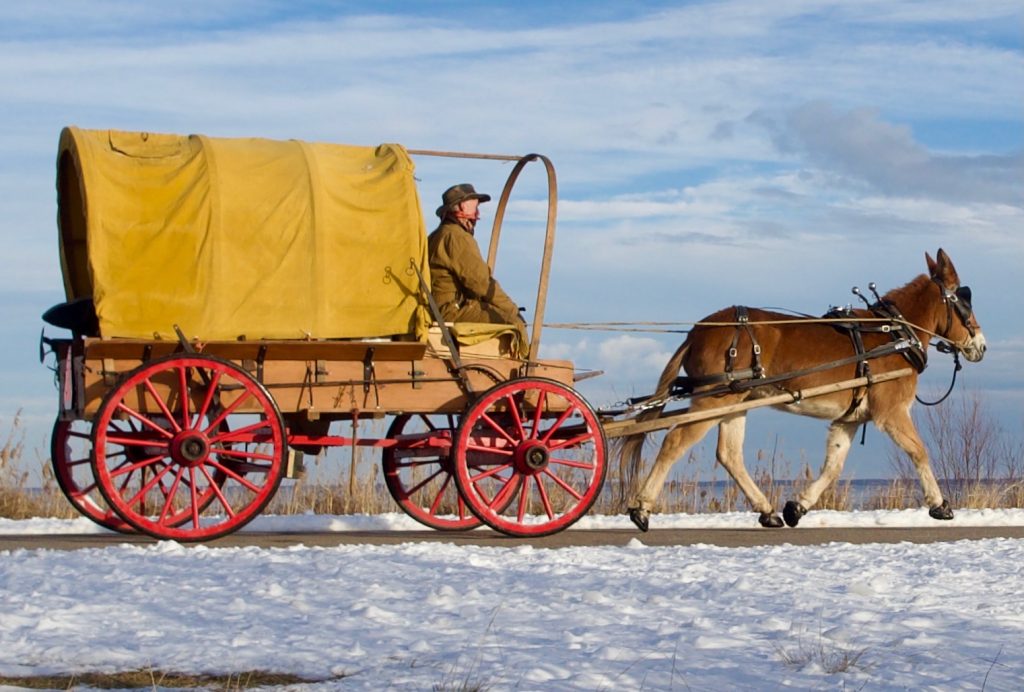
Mule Polly heading across a snowy Lake Mattamuskeet causeway. That homemade wagon cover looks sharp, doesn’t it! Note how I have the front quarter tied back so that I can see out. (Tom Carmine photo)
Swan Song. That’s Thomas Midyette sitting next to me. Thanks, Thomas, for the collards!
Watch Another One of my Wagons in Action — The Lost Sea Expedition Free on YouTube
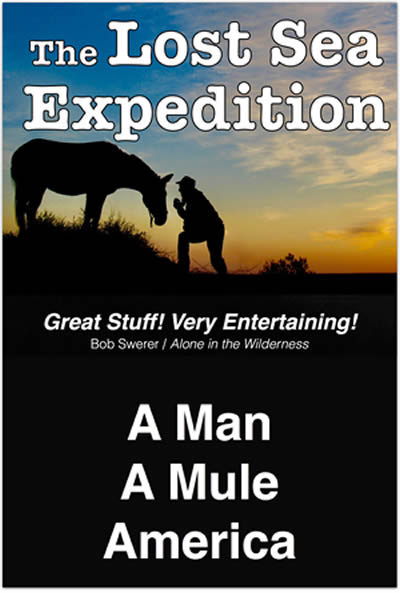
Twenty years before mule Polly and I took our Lake Mattamuskeet ramble, we traveled across the United States in another small wagon that I built in a friend’s garage. That journey lasted 14 months and carried us from Neptune, Saskatchewan to Fort Hancock, Texas on the border with Mexico. I filmed the whole voyage myself. No crew. No drones. No AI. Just some paper maps, two movie cameras, Polly, and our handmade wagon.
The Lost Sea Expedition premiered on Rocky Mountain PBS and won the WINNIE Award at the EQUUS International Film Festival. For the first time, the full, uncut, original feature-length version is free to watch on YouTube.
Pick up a Copy of my New Book Two Mules to Triumph
If you’re looking for a gift sure to bring a smile to your or someone else’s face, Two Mules to Triumph will do the trick. It’s the perfect present for anyone who enjoys stories about animals and adventure travel, especially adventure travel with horses and mules.
Two Mules to Triumph is about my 2,300-mile mule voyage through America with my mules Brick and Cracker.
Sign up for The River, the RiverEarth newsletter, for occasional doses of rambling and homestead life. Plus you'll get a free copy of my 155-page illustrated ebook 19 Million Mule Steps.






Leave a Reply