There was the jockey phase, the Alfa Romeo mechanic phase, the running-out-of-money-in-Tuscany-and-spending-a-year-to-earn-a-plane-ticket-home phase, and then at age twenty-five I went to NC State University. I got a degree in Wood and Paper Science and a few years later started the phase most folks had a head start on. That was the Office Phase.
Control-Z
I went to work for a German wood-working machinery company and it was a great job. Best job I could have imagined straight out of college. They sent me to meetings in a plane and put me up in hotels and put me in charge of training their sales agents. It was a fine job, really. And I’ll be forever grateful they took me on.
It allowed me to slip seamlessly into the lifestyle that my peers who hadn’t taken the same detours were on. It was the early nineties, that magical time when college grads could toss their graduation caps into the air and step into a high-paying career. I bought a home on Lake Norman and a black Volvo 240 Turbo and commuted half an hour to work with the sunroof open, wind blowing through my hair, sun glinting off my Ray Ban shades.
And I loved my job.
Part of my job was editing photos of cutter heads on the computer. I wasn’t great at it so I made lots of mistakes, like putting six knives on a cutter head that only held five. This was before AI, so it was lots of digital tweaking and nudging. To save time, I learned that I could undo my mistakes by hitting the “Control” and “Z” key at the same time.
It didn’t take me long to get good at this. Mistake, twitch of the finger, mistake gone.
I worked faster, went to more meetings, put more miles on my Volvo and spent less time looking at the lake in front of my home.
Then one day I spilled a cup of coffee and my fingers twitched for the “Control” and “Z” key, like they could undo the action.
“Oh God! I’m thinking like the machine!” shot through my head. If this was my future, I decided there on the spot, I’d better start living another life.
So I put in my notice, trained my replacement and cashed in my Roth account. It yielded 500 dollars. But that was enough.
Boats, horses, something else, my life had gone.
I’d just finished a “something else” phase so it seemed natural I jump back to the boat phase.
The Boat at the End of Larry’s Dock
While all this life stuff was going on, I noticed there was an old sailboat tied off to a dock down the cove from where I lived. The white paint was flaking off her bow. She had water pipes for masts. They were chalky and hadn’t seen a sail in years. At the time, I owned a small row boat. One day, as I was rowing past this boat, I noticed the owner was sitting on the dock, looking at her. I introduced myself, he said his name was Larry, and he gave me the quick version of how this salty but run-down boat had ended up on the end of his dock.
The boat’s name was Sea Bird.
She was designed by Tom Colvin, his Saugeen Witch design, and built in 1984. She measured 34 1/2 feet on deck, displaced 14,000 pounds and drew 3 feet 9 inches of water.
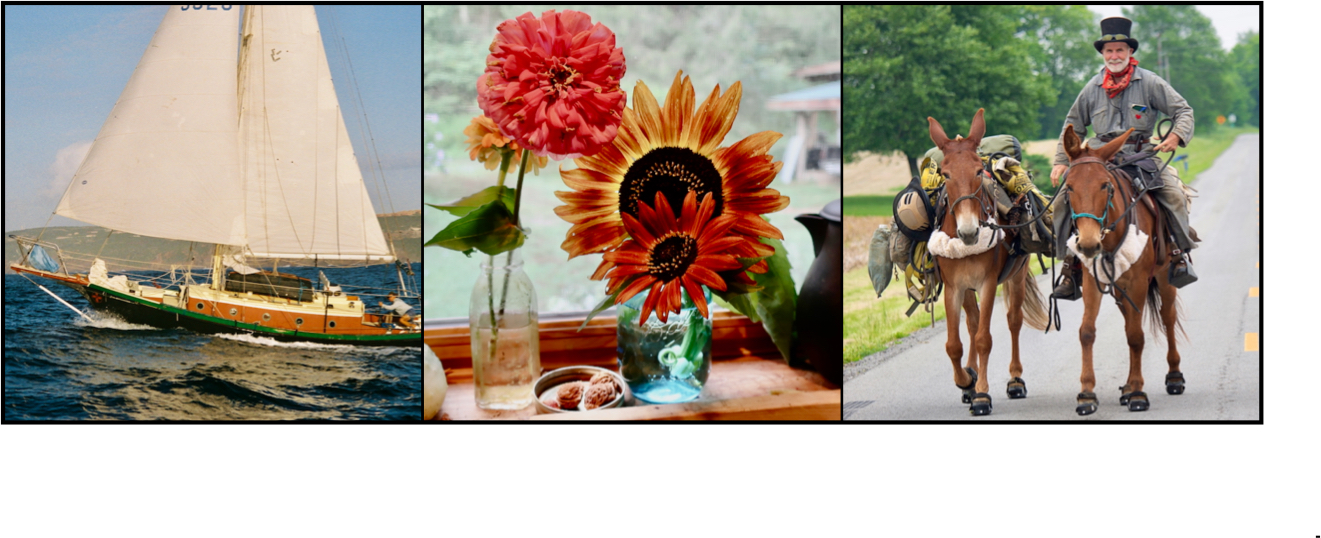
Sea Bird as I found her in Doolie, North Carolina in 1997
She’d been built in San Diego and sailed to Hawaii by her first owner. Larry had bought her there and sailed her back to the States. He was married at the time, and by the time he arrived back at the East Coast, his wife informed him that she was leaving him.
Larry had Sea Bird hauled to Lake Norman, an odd place to have a 34 1/2′ steel sailboat. He didn’t sail her much to begin with and, as the years passed, she just sat at his dock.
Larry took me aboard Sea Bird and she looked like a mahogany chest with portholes. Solid. Stout. The type of boat I had always fantasized about. She wasn’t fancy. She didn’t have winches, and her motor, an old single-cylinder Volvo MD 1B, didn’t have a starter motor. To start it, you had to stick a handle in a slot in front of it, drop the decompression lever and crank like hell.
She was like starting a Model T, and she sounded like the African Queen.
I was smitten. A few months later, I bought her. The next day, I turned in my resignation. It was August. Paul Welles of Triton Yachts, a boat hauler, hauled her to Oriental, North Carolina for me.
All the rest of that summer, I sanded and painted and worked on her. I scraped the bottom, rolled on new bottom paint, fitted her with an observation dome made out of a propane tank and, in short order, I spent what money I’d saved at my job getting her seaworthy.
The days tipped from boiling hot to hot to perfectly temperate to November. She was ready enough to go by then, so I launched her and set off on my grand adventure. Little did I know that, four weeks, 1,900 sea miles and a breakdown later, my life would go back to horses. But that time it didn’t matter. I was in the Caribbean.
Sign up for The River, the RiverEarth newsletter, for occasional doses of rambling and homestead life. Plus you'll get a free copy of my 155-page illustrated ebook 19 Million Mule Steps.







Leave a Reply