Three Things I Learned Riding 2,300 Miles in Hoof Boots
I, Bernie Harberts, did not use generative AI to write or illustrate this article. Spell check and grammar check, yes. AI, no.
A while back, I rode my mules Brick and Cracker 2,300 miles in hoof boots from North Carolina to Idaho. In this post, I’ll share three key lessons I learned from that experience. Whether you ride horses or mules, or if you’re planning a weekend ride or a Long Ride of over 1,000 miles, if you you’d like to learn more about hoof boots, this article will interest you.

Shop now at: Amazon / Barnes & Noble / Kobo / Download on Kindle


While this post is about my experience with hoof boots and mules, everything that I learned applies to horses, too.
It’s About The Fit, Not the Brand.
The most common question I get about hoof boots is, “What’s your favorite brand of hoof boot?” I’ve traveled over 10,000 miles with hoof boots. But the brand of hoof boot I use in my travels isn’t why I’ve gotten so far with them. I’ve gotten great results with four different brands of hoof boots, including Easy Boot Gloves, Cavallos, Scoots and Renegades. What counts more than the name of the boot is how well that boot fits my mount’s feet.

I used Renegade hoof boots on my latest seven-month long ride. I’ve traveled over 5,000 long distance miles with Renegade boots and have found them to be heavy-duty, easily adjustable, and repairable. They are perfect for long, slow journeys through challenging terrain, especially for someone who’s handy with a screwdriver, an allen wrench and is happy doing a bit of tinkering with their gear.

I have also ridden thousands of miles with Scoot boots, Cavallo boots and Easy Boot Gloves. These boots are lighter than the Renegades and don’t have the buckles and cables like Renegade boots do. The Scoot and Cavallo boots take a few seconds less to put on than the Renegades. The Easy Boot Gloves’ lower profile makes them better suited for fast activities like endurance riding, eventing or show jumping.
And yet, the Scoot, Cavallo and Easy Boots weren’t a great fit for my mule Cracker, one of the two mules I took on my journey.
Most hoof boots are designed for horses. That means the boot’s heel, the part that covers the fleshy bulb of the hoof, is relatively short, sort of like a sling back shoe. But Cracker, like many mules, has a really tall heel. When I fit him with Scoot, Cavallo and Easy Boots, the fit was tight in the heel. This was no fault of the boots’ designs. They were, after all, designed for horse heels, not mule heels.
Yes, I’ve trail ridden Cracker in Scoot, Cavallo and Easy Boots. But for a journey of thousands of miles, where he’d be wearing the boots day after day for months, they weren’t a good fit.
Not for Cracker, at least.
My other mule, Brick, has much lower heels. She fits fine into Scoots, Cavallos and Easy Boots. And yet I used Renegades on her because it was easier for me to travel with one brand of hoof boot for two mules instead of two brands. And just to show you how lucky I am, both my mules have the same hoof size — 00. That meant I only had to carry one size of hoof boot as well as spare parts that fit all of my boots.

Keep the Hoof Trimmed if you Want the Boot to Fit
The second thing I learned on my long ride was that even if your hoof boot fits your horse or mule’s foot perfectly when you first fit it, in six weeks, it could be a whole different story. Before I initially fitted Brick and Cracker with hoof boots, I trimmed their feet. Their hoof boots slid on nice and easy and fastened into place with minimum effort. About three weeks later, they started getting a little harder to slip on. After six weeks, I had to pound them on with my fist and then tug hard to get the heel captivator, the part that fits over their heels, to slip into place.
That’s because their feet were growing. The hoof was getting harder to fit into the boot because their toes were growing. The heel captivator was harder to slip into place because their heels were growing.
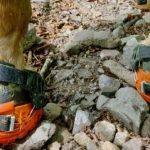
In the photo below, you’ll see what a difference a light hoof trim makes. The feet pictured belong to my wife Julia’s Arab-cross Magneto. The first photo is his rear right foot. It was getting hard to fit into the hoof boot. Note how the front of the hoof is squared off, not rounded. The second photo shows the hoof after I rounded the front of the toe with my rasp. Aside from that, I didn’t have to do much else.


While, yes, I could have adjusted Brick and Cracker’s hoof boots by loosening some straps and cables, what I really needed to do was trim their feet. Luckily, that wasn’t a big deal. I carried a half a rasp in my saddle bag (cut in half to cut weight). Every two to three weeks, I just rasped a bit of hoof off the toe and the heel and their hoof boots went back to fitting as smoothly as the day I’d fitted them.
You’re Not Going to Use Your Hoof Boots all the Time
The third thing that I learned on my voyage was that a lot of the time I could ride my mules barefoot, without any hoof boots at all.
It’s sort of like when you were a kid and ran around your neighborhood barefoot (well, at least I hope you did). The first week of summer, when you shucked off your shoes, your feet were tender and white. The skin on the bottom of your soles was so thin you could barely walk across your lawn without flinching. But summer’s call was strong and before you knew it, you were running around all day long, barefoot.
By the end of the summer, if you had a gravel road running in front of your home, like I did growing up, you could run up and down it, barefoot. Of course, you’d make a big show of this when grown ups (shoe-wearing grown-ups, of course) were around. They’d say, “Wow, you have tough feet.” And you’d feel like the toughest nine-year-old bad ass. Which, of course, you were.
The same thing happened to my mules during the course of my trip. When I set out from North Carolina in early spring with my mules, their feet were tender. Sure, I could ride them barefoot. But for the most part, I rode them in hoof boots to give them some extra protection.

Over the course of my trip, though, I rode them barefoot more and more. Sure, there were times when I had to use hoof boots, like if I was riding on gravel roads, abrasive cement or garbage-strewn highway shoulders. But as their feet got tougher, I was able to ride them day after day across deserts, over mountain passes and along country roads.

By the end of my trip, I would estimate that I rode a third to a half of the time barefoot. If I’d been traveling cross-country, instead of on asphalt, I could have traveled barefoot even more.
Looking Back at it All
Looking back at my saddle journey through America reinforces my belief that hoof boots are a great option for many people, be it for a Long Ride of thousands of miles or an afternoon trail ride. I punished the crap out of my boots and they held up fine. By focusing on the fit instead of the brand, keeping the mules’ feet correctly trimmed and letting them walk truly barefoot, I was virtually assured of success.

Check out the Grand Daddy of All Hoof Reports
I hope this article gives you a deeper understanding of how you can make hoof boots work for you. If you’re interested in an in-depth report on how hoof boots work out in the field, check out The Hoof Boot Report. It’s about a six-week long trip that my wife Julia and I took with three mules wearing three different kinds of boots. It’s the most in-depth review of hoof boots on the internet and should help guide your thinking on what brand might work best for you.

If you have any questions, comments or thoughts about your experience (or inexperience) with hoof boots, feel free to leave a comment in the Comment section below. Happy booting!
Let's Keep in Touch
Sign up for The River, the RiverEarth newsletter, for occasional doses of rambling and homestead life. Plus you'll get a free copy of my 155-page illustrated ebook 19 Million Mule Steps.
Explore More of RiverEarth




Leave a Reply