Wild Ponies of Shackleford Banks Have the Last Word
PublishedApril 16, 2026
I, Bernie Harberts, did not use generative AI to write or illustrate this article. Spell check and grammar check, yes. AI, no.
It was our last day observing the wild ponies of Shackleford Banks and my wife Julia and I went out to see what they were up to.
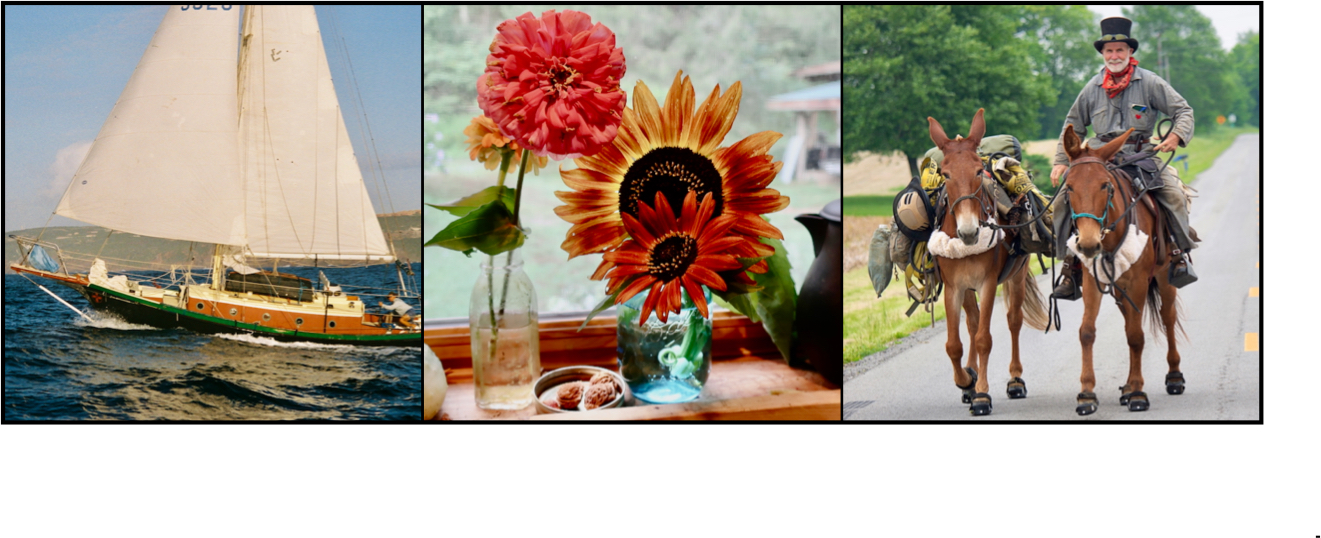
Julia observing a band of wild ponies from the top of a sand duneJulia walking back to Grit after visiting the wild ponies. Grit is barely visible anchored in the dark blue water off the beach.Julia paddling back to Grit. Grit was our home base for the time we spent on Shackleford. She is a 1992 Nimble yawl.
We’d come to Shackleford Banks to learn from the wild ponies that call the 9-mile long uninhabited island home. We came with open eyes, telling ourselves we would just watch the ponies and let them be our teachers. We would have no agenda. They would be the master teachers and we would be the students. And so far, they had been amazing teachers.
For the past two weeks, we’d gone off into the sand dunes every day armed with sunblock, binoculars, two quarts of water, peanut butter sandwiches and to see what the wild ponies were up to. Getting ashore each day was its own adventure — we paddled the kayaks in from Grit, the same two kayaks that sank on our first day out.
After half a month of studying them, we were building a solid understanding of the organizational groups the bands of wild ponies were made of — the stallions, the lieutenant stallions, the mares and how they were connected, both as individuals in a band of wild horses and bands of wild horses living among other bands of wild horses.
The experience felt like an immersive documentary where we, the viewers, sat on a sand dune for hours every day and the main characters, the wild ponies of Shackleford Banks, filled us with knowledge as they went about their days. We saw how an established band mare will drive a younger mare back to the herd. We observed a mare watch over her foal as she slept. We marveled how a horse that got by nibbling cord grass and sipping brackish water could produce perfect windswept manes and tails thick as shrubs.
Two young ponies and an older mare grazing among the edge of the maritime forest that grows along the sound-side of Shackleford BanksA bay mare as seen between two shrubs. This photo was taken with a zoom lens to give the wild ponies the distance they deserve.
So the last day, we were excited to get one last installment of the various story lines we’d been watching all week. It was like we were getting to watch the last episode of an incredible documentary on wild horses where we knew all the actors. We’d seen ponies every day, consistently, in much the same areas. We knew 12N was a mare that held a lot of important knowledge. We knew the Glamorous Couple would be browsing muzzle to muzzle. We knew the Ginger Stallion would look fabulous standing on a sand dune backlit against the Atlantic Ocean as his flaxen mane streamed in the wind.
The glamorous stallion we always looked forward to seeing
Because the story we’d gotten drawn into over the last two weeks was so fantastic, we had, unknowingly, slipped into exactly what we’d set out not to do. We now had an agenda of what we wanted and expected to see next. Of course, living aboard Grit in a narrow channel between two sandbars had taught us that life in eight feet has a way of rewriting your plans.
We walked through the dunes to where we’d been observing a band of five wild ponies — the main stallion, the lieutenant stallion, two mares, and a third mare. The day before, we’d watched the lieutenant stallion chase off another stallion. We wondered what we’d see today.
The scene we were expecting to seeWatch this video to get Julia’s in-depth description of the herd we were looking for. This video was filmed earlier in our visit.
We walked across the first dune. We didn’t see anything so we walked across the next dune, sure, as had happened the last few days, that we would be rewarded with wild ponies. We got to the wide depression in the dunes where we’d found them the last three days. It was pony paradise — short-cropped centipede grass, quarter-sized penny wart and a few shrubs to stand behind to break the wind. Instead of ponies lying there napping, eating, grazing, it was empty. Totally empty.
The type of grazing the wild ponies of Shackleford prefer. The short green grass is centipede grassCentipede grass and penny wort
The Atlantic Ocean shimmered in the background. Waves curled and pounded on the sandy shore. Terns dove just out past the surf line and black headed sea gulls wheeled in the blue sky.
The view on the other side of the sand dunes
We walked to the next dune lugging our backpack, binoculars, two quarts of water and sack lunch. I was getting impatient to find the ponies for no other reason than to sit down in the sand and eat lunch. But no ponies. We walked another half a mile through the sand dunes, drawn by what we hoped would be the final lesson the ponies would teach us. If only we could find them.
We didn’t find any ponies.
We finally decided that, instead of walking farther down the dunes, we’d step into the maritime forest that borders the sound side of Shackleford Banks and walk through the forest back to Grit. Maybe we’d find the ponies in there.
We walked into the forest. The wind off the ocean dropped and waves sounded muffled. We walked past giant, gnarled live oaks with bark lumpy as alligator hide. We brushed against a bush with dark, olive shaped leaves and smelled wild bay. We snapped off dead cedar branches to get by overgrown spots in the trail and the air smelled like hamster bedding. Green anoles hopped from limb to limb and we made sure not to touch the poison ivy.
Shackleford Banks anole lizard sitting on a mossy oak branchEntering the maritime forestAncient oaks twisted by stormsJulia standing in front of a massive live oak. These trees were sought after by the early Shackleford Islanders for boat building, especially the curved branches that were prized for knees and stems in boats
But we didn’t see any ponies.
We ate lunch under a giant oak tree with enough twisted branches to provide a boat builder with enough knees to build a sailboat. I shared my cheese sandwich with a tiny brown ant and decided I would write a post called “Obituary for a Paper Bag.” Our friends Gil and Laura had given us a paper bag full of chocolate chip cookies before we’d set out on our trip. The cookies were gone but we’d used the paper bag for sandwiches. It was wearing out but I’d become mighty attached to it over the last two weeks.
Our beloved paper sackThe contents of our bag lunch: cheese sandwiches and home made sausage I made with our neighbor’s Chris and Emily Barlowe’s sausage
Then we kept walking through the forest, eyes open for ponies.
We elbowed our way through a low tangle of fallen cedar trees and stepped out onto a long sandy beach that stretched all the way to where Grit was anchored. Still, no ponies. It had been a close call getting Grit to this anchorage — we’d gone adrift and fouled our anchor a few days earlier so it always felt reassuring to see her stubby masts in the distance.
The sandy beach we came out on. Look closely and you’ll see Julia just below the clump of trees in the distance.
I thought of what an amazing two weeks we’d had on Shackleford Banks observing the ponies and how I’d had this agenda to watch the final episode of the documentary we’d seen playing out among the ponies on the sand dunes. And now it looked like we weren’t going to see it.
Julia and I walked up the beach toward Grit.
We came to a set of pony hoof prints running up the beach. That was the only evidence we’d see of the ponies.
We’d seen ponies every day we’d gone ashore looking for them. But not today. They had just vanished into the salty air.
I had to smile. That was their last lesson for us. Whatever you set off looking for in life, hold it loosely in hand. Some days you set off looking for ponies but all you find is hoof prints. Let that be enough.
Julia’s side of the voyage at Saddle Under the Stars:
Sign up for The River, the RiverEarth newsletter, for occasional doses of rambling and homestead life. Plus you'll get a free copy of my 155-page illustrated ebook 19 Million Mule Steps.




Leave a Reply