I, Bernie Harberts, did not use generative AI to write or illustrate this article. Spell check and grammar check, yes. AI, no.
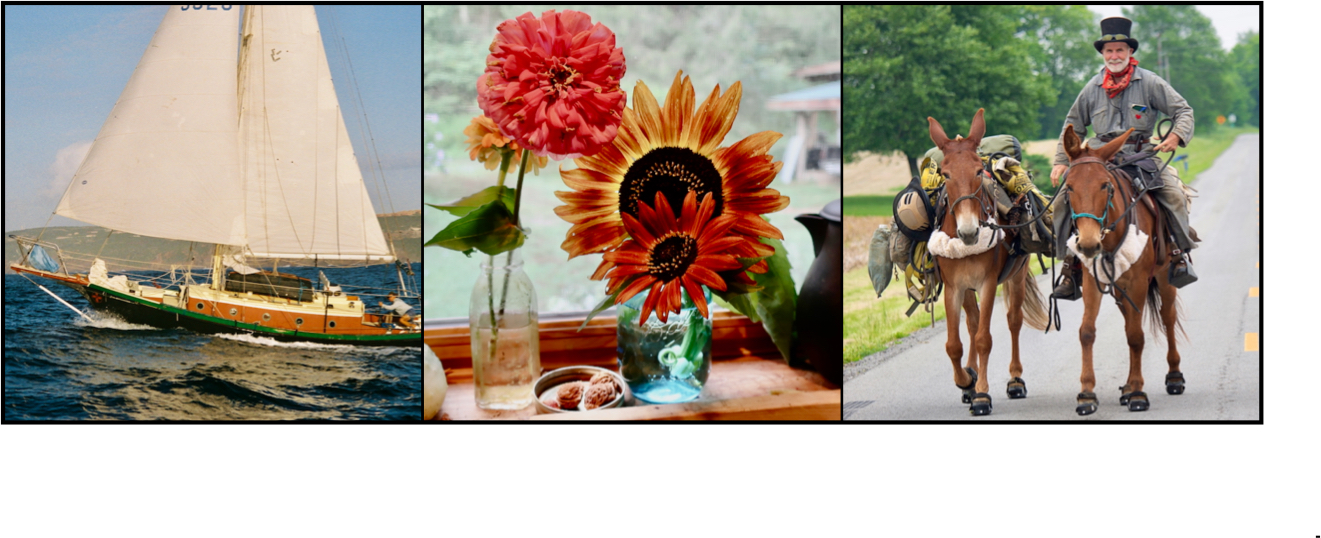
My wife Julia and I had spent the afternoon observing the wild ponies on the middle part of Shackleford Banks and were following a sandy beach back to Grit, which was anchored just off the beach.
Julia carrying her kayak back to Grit, which is anchored in a narrow channel just off the beach
The tide was high and we came to a tangle of trees that had fallen across the beach, making a barrier between land and water. The tangle was too thick to crawl through, so we ducked into the maritime forest growing on the edge of the beach to get around the blown-down.
Julia inspecting a lichen colony on the edge of the maritime forestClose-up of lichen growing on Shackleford BanksJulia squeezing under a coastal red cedar branch
We entered a magical forest. The temperature dropped five degrees and I took off my sunglasses to see what we’d stepped into. Dark branches blotted out the sky and I felt a calm descend. We’d gone from dune life under a hard sky to what felt like a temperate rain forest.
Click on the player to walk into the enchanted forest with me
I touched the peeling bark on a wind-blown coastal cedar tree with trunks big as a barrel. It felt like rope. Other trees looked like giant tangled octopuses, their arms twisted and gnarled around each other. We walked by a giant live oak that looked like an upside down tree — the trunk went up eight feet then split into five limbs big around as my waist that grew parallel to the ground.
You could have hung a thousand swing sets in that forest and still had plenty of leftover trees reaching out for a swing.
The perfect branch for a swing. The Shackleford Bankers that called the island home prized these angular live oak branches and crotches for boat building, especially for building stems and knees for everything from skiffs to schooners.
The salt water smell we’d lived with for the past two weeks gave way to the smell of a greenhouse two hours after the sprinklers have gone off and the water has dried up — a mix of damp leaves and soil.
And there was no garbage.
That’s one of the things that saddened Julia and me about Shackleford Banks. For all its natural beauty, it had a thick crust of litter swept across it as though by a giant wave — plastic bottles, hat visors, pressure treated boards, lengths of fishing line, styrofoam cooler lids, and, especially deadly to wildlife, Mylar balloons.
There were so many Mylar balloons. Happy Birthday balloons caught by their white ribbons in bushes. Get Well Soon balloons buried in the sand. Balloons with the messages bleached off them by the sun crumpled in cord grass clumps. It made me think of the mystery of the two sea turtles I’d found earlier on the beach.
Feel Better!Happy Birthday!
But not here. The forest floor was immaculate, covered in a carpet of live oak leaves. It just felt so pure and peaceful, as though it had escaped humankind’s garbage.
Click on the player to join me for a short walk through the Shackleford Banks maritime forest
We kept walking. A yellow flower on the forest floor caught my eye. Jasmine. A green anole lizard skittered away and a black carpenter bee buzzed by. I stopped to photograph a peculiar knot on a cedar tree. It looked like a goiter on an old woman’s neck. It was crawling with large black carpenter ants.
The peculiar knotA closer lookJasmine flower on the forest floorFrom when the flower fellCarpenter ants exploring a cedar tree
The forest was hushed.
We climbed what must be one of the tallest hills on Shackleford island — a hump of sand surrounded by gnarled, twisted oaks whose drooping limbs look like the walking canes they need to stay upright.
The ground was spotless. And there were no pony trails or manure piles to be seen. Shackleford Banks is crisscrossed with pony trails, some only a few feet apart. In many cases, they run from manure pile to manure pile. That’s how the stallions mark their territory. But not here.
None.
That feeling of calm that I’d felt when I entered the forest had only grown deeper. Now I felt like I was in a cathedral.
It felt like they only ever came here in hard times — when the hurricanes flooded the low lying dunes, when the winter snows piled huge drifts on the sand dunes and when the heat waves turned the cedar sap soft. Aside from that, they avoided it, so that it would be there, safe, sound, clean and un-tracked, when they needed it.
I looked at Julia and said, “It’s like the ponies treat this like their church. You don’t shit in church, and you don’t shit here.”
We poked out of the enchanted forest a few hundred feet from where Grit was anchored and stepped back onto the sand and cord grass-covered dunes.
A wad of silver material under a cedar tree caught my eye. It was a Mylar balloon fallen from the sky. And next to that, a yellow light bulb next to a pennywort leaf. This was just a fraction of the trash we’d seen strewn across the island, much of it washed ashore by storms and high tides.
The tangle of Mylar balloons, one of many we found on Shackleford BanksLight bulb and penny wortA wild pony walks by a tangle of garbage swept into the dunes that the ponies feed in
The sight tempered the calm I’d felt in the sacred forest — sort of like coming out of a church and finding a garbage truck had dumped a load of trash on the walkway while you had your head bowed.
I picked up the Mylar balloon and stuffed it into my back pocket.
Julia and I went back to Grit. I threw the balloon in the trash and, blessed with a memory that replaces the unpleasant with the pleasant, went about typing up my notes for the day. We wrote for half an hour, and then I said, “Honey, I just wrote a piece about that enchanted forest we visited and how it felt like it was sacred to the ponies.”
She smiled the smile she smiles when we’re on the same wavelength and said, “I did, too.”
A few days have passed and I now think of the maritime forest we entered as the Sacred Forest. It’s taken on a bigger meaning than just where the ponies go when the going gets rough.
That forest felt like a symbol of what the whole island should be — to the ponies, to the wildlife, to us. Shackleford Banks has been home to wild ponies for 400 years. They’ve pretty much figured out how to cope on their own. So has the forest.
Sometimes, you protect what matters most to you, whether you’re a pony or a person, by leaving it alone.
The sacred forest as I remember it – and the way I hope it will always remain
Julia’s side of the voyage at Saddle Under the Stars:
Sign up for The River, the RiverEarth newsletter, for occasional doses of rambling and homestead life. Plus you'll get a free copy of my 155-page illustrated ebook 19 Million Mule Steps.




Leave a Reply